Hand & Low-Tech Lift Pumps
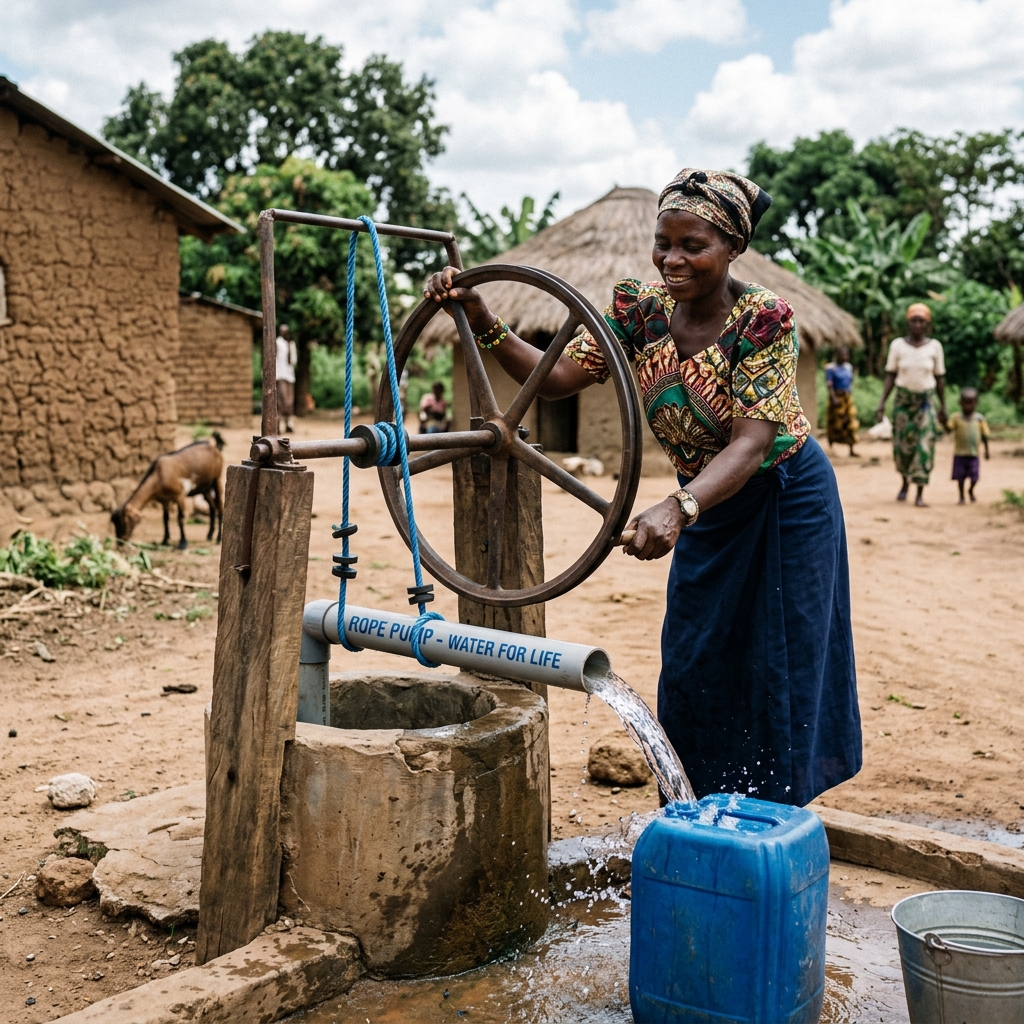
Hand pumps provide water access for hundreds of millions of rural residents across Africa, Asia, and Latin America. Choosing the right lift mechanism depends on groundwater depth, community population density, and local spare-parts supply chains.
1. Common Hand Pump Standards
A. Afridev Hand Pump
- Standard: Standardized by SKAT / RWSN for Village Level Operation and Maintenance (VLOM).
- Depth Range: 10m to 45m.
- Key Advantage: The plunger and foot valve can be extracted directly through the 63mm PVC rising main using a fishing tool, without unbolting or lifting the heavy drop pipes.
- Wear Components: Nitrile rubber U-seals, bobbin valves, brass rod centralizers.
B. India Mark II & Mark III
- Standard: Standardized by UNICEF and Bureau of Indian Standards (BIS).
- Depth Range: Up to 70m (Deep Well configuration with heavy counterweighted handle).
- Key Advantage: Heavy cast-iron pedestal with hot-dip galvanized steel head and sealed ball bearings; highly vandal-resistant and durable in high-density communal settings.
- Mark III Difference: Features an open-top cylinder allowing plunger extraction without pulling the entire pipe string.
C. Rope Pump (SMARTech)
- Design: Continuous loop of rope with rubber/polyethylene pistons traveling up an unthreaded PVC pipe.
- Local Production: 100% locally fabricated using scrap car tires, bicycle hubs, and standard local plumbing pipe. Costs ~$70–$120 USD.
- Limitation: Shallow unconfined water tables (<35m); requires regular rope splicing every 6–12 months.
2. The Hydraulic Limit & Queue Physics (The 350-Person Reality)
A critical error in WASH planning is dividing total well cost by an entire village population (e.g. 1,000+ people), assuming one handpump can serve everyone.
The Hydraulic Mathematical Proof:
- Discharge Rate: A standard Afridev or India Mark II handpump yields 12 to 15 liters per minute (approx. 720–900 L/hour) under steady, continuous pumping.
- Sustainable Daily Pumping Window: In practice, rural community collection is concentrated during early mornings (6:00–9:00 AM) and late afternoons (4:00–7:00 PM), averaging 8 to 10 hours of active pumping per day.
- Daily Water Yield: $$\text{Maximum Sustainable Output} = 15 \text{ L/min} \times 60 \text{ min/hr} \times 8 \text{ hrs} \approx \mathbf{7,200 \text{ Liters / Day}}$$
- Per Capita Demand: Under the WHO and Sphere Humanitarian Standards, the minimum baseline for drinking, cooking, and basic personal hygiene is 20 Liters per person per day.
- Maximum Sustainable Population: $$\text{Population Capacity} = \frac{7,200 \text{ Liters}}{20 \text{ Liters / Person / Day}} = \mathbf{360 \text{ People (Standardized to 350)}}$$
What Happens When 1,000 People Share One Handpump?
- Serving 1,000 people at 20L/day requires 20,000 Liters daily, demanding 22.2 hours of non-stop, maximum-speed pumping every single day.
- Queue Bottleneck: Women and children wait 3 to 4 hours in line before dawn.
- Accelerated Mechanical Failure: Friction on nitrile U-seals and pivot bearings triples, causing pump breakdown within months.
- Disease Backsliding: Frustrated families abandon the queue and return to contaminated surface ponds or drainage ditches.
- The Engineering Solution: Communities exceeding 350–500 people must either drill a second borehole or upgrade to a solar-powered submersible DC pump discharging into elevated storage tanks (5,000L–10,000L) with multi-tap distribution kiosks.
3. Mechanical Rehabilitation Protocol ($245 – $1,500 vs. $10,000+ New Drilling)
Sector audits by RWSN, UNICEF, and Uganda's RUMIS reveal that over 80% of "broken wells" across Africa have intact underground hydrogeological boreholes and casings. The well stopped producing water solely because internal mechanical wearable parts failed.
Typical Mechanical Failure Modes:
- Worn Nitrile U-Seals ($10–$25): The rubber cup seal loses elasticity from abrasion, allowing water to slip backward past the piston without lifting.
- Snapped Connecting Rod ($30–$60): Repeated tension fatigue snaps stainless steel sucker rods at the threaded male/female joint.
- Worn Handle Axle Bearings ($15–$35): Heavy daily pumping wears down sealed ball bearings, jamming the handle pivot.
- Corroded Galvanized Riser Pipe ($30–$50/length): Aggressive groundwater corrodes galvanized steel pipes, causing pinhole pressure leaks.
Standard 5-Step Field Overhaul Procedure:
- Safety Clamping: Secure the rising main at the wellhead using an approved pipe clamp. Never pull rods without safety clamps; dropped pipe strings can permanently wedge inside the borehole.
- Rod & Cylinder Extraction:
- On Afridev pumps: Drop a fishing tool down the 63mm PVC rising main to latch and extract the foot valve and plunger.
- On India Mark II: Use a rod elevator and pipe wrenches to pull 3-meter rod sections, unthreading each joint carefully.
- Internal Cylinder Overhaul:
- Clean the brass or stainless steel cylinder sleeve.
- Replace the nitrile U-seal, bobbin valves, and O-ring gaskets with fresh manufacturer-spec kits.
- Surface Maintenance: Replace handle axle pins and bearings; check concrete sanitary apron for cracks and regrout with waterproof cement.
- Shock Chlorination: Dose the borehole casing with calcium hypochlorite (HTH) solution (yielding 50–100 mg/L free chlorine), let sit for 12–24 hours, and pump to waste until chlorine smell dissipates before clearing for public use.
4. Open-Access Educator Lesson Plans & Technical Manuals
Community Facilitator Lesson Plans (CAWST)
- 📖 Sanitary Inspection & Wellhead Protection Lesson Plan: Download Facilitator Lesson Plan — Complete 45-minute workshop session plan teaching village water committees how to inspect handpumps for apron cracks, animal fencing, and latrine contamination risks.
- 📖 Community Water Committee Governance & Maintenance Toolkit: Download Committee Facilitator Guide — Training guide for establishing monthly household maintenance tariffs, recording spare parts logs, and organizing community work parties.
Technical Engineering Guidelines
- 📄 CAWST Handpump Maintenance Overview: Download Maintenance Job Aid
- 📄 RWSN Handpump Technology Guidelines: Rural Water Supply Network Handpump Specifications
- 📺 WHOlives Village Drill Field Operation: Watch Field Rig Operation